Learn to scientifically allocate positions and avoid being shaken out by short-term market volatility due to heavy positions. Even if your analysis is spot on, poor position control means you cannot hold until the profit moment.
Introduction: A Familiar Story
Have you ever experienced this scenario?
You spent several nights researching and finally found the perfect stock. Strong fundamentals, beautiful technical patterns, bright industry prospects. You were convinced this stock would soar, so you decisively put all your capital — let''s say $100,000 HKD — into it.
The first two days, the stock price rose slightly. You were satisfied.
On the third day, negative news suddenly hit the market, and the stock price plunged 10%. You told yourself: "Just short-term volatility, it''s fine."
On the fourth day, another 10% drop. Your account went from $100K to $81K. Your palms started sweating.
On the fifth day, another 10% drop. Your account was left with less than $73K. You finally couldn''t take it anymore and pressed the "Sell" button.
What happened? Two weeks later, the stock price not only recovered but broke to new highs, surging to $12, $13, even $14.
You picked the right stock, but you lost money.
Why did this happen? The answer is just two words: Position Sizing.
Why is Position Sizing More Important Than Stock Picking?
Many people think trading success comes from "being right." Being right is certainly important, but there is a more critical and often overlooked factor: can you hold on until the end?
The market is always full of uncertainty. You can analyze the current market conditions through Regime & Risk. Even a stock with excellent fundamentals can experience violent fluctuations due to short-term market sentiment, macro news, or institutional operations. If your position is too heavy, these fluctuations will directly impact your psychology, causing you to exit early out of panic even when your judgment is correct.
💡 Core Concept
Stock picking determines your potential return; position sizing determines whether you survive to collect it.
Even with a 90% win rate, if you go all-in every time, just one mistake can wipe out all your previous gains.
Scenario 1: The Deadly Trap of Going All-In
Let''s use a concrete example to understand the risk of full-position trading.
Assume your capital is $100,000, and you find a stock priced at $10. Because you are extremely confident in this stock, you decide to go all-in.
Three days later, the market experiences consecutive adjustments due to macro factors, dropping 10% each day:
| Day | Decline | Account Value | Cumulative Loss |
|---|---|---|---|
| Initial | — | $100,000 | — |
| Day 1 | -10% | $90,000 | -$10,000 |
| Day 2 | -10% | $81,000 | -$19,000 |
| Day 3 | -10% | $72,900 | -$27,100 |
In just three days, your paper loss exceeds 27%, with $100K shrinking to less than $73K.
⚠️ The Psychological Impact is Real
A -27% paper loss is painful for anyone. Even if you rationally know "this is just a short-term adjustment," watching your account shrink daily drives human fear to push you toward irrational decisions — exiting at the worst possible time.
The reality is that this stock may later recover to $12, $13, or even $14, growing your assets to $130K or even $140K.
You were right about the direction, but you got shaken out because your position was too heavy.
Quiz
With $100,000 capital, going all-in on a stock that drops 10% for three consecutive days, how much is left?
Scenario 2: The Calm Response of Scientific Position Sizing
Now let''s look at the same scenario, but with proper position control. See how different the outcome is.
You still have $100,000 capital and are equally bullish on that $10 stock. But this time, you only commit 20% of your capital, i.e., $20,000.
The market still drops 10% for three consecutive days. Let''s compare the two approaches:
| Full Position | 20% Position | |
|---|---|---|
| Capital Committed | $100,000 | $20,000 |
| Loss on that portion after 3 days | -$27,100 | -$5,420 |
| Impact on total capital | -27.1% | -5.4% |
| Remaining available capital | $0 | $80,000 |
The $20,000 invested also dropped about 27%, losing $5,420. But relative to your $100,000 total capital, the paper loss is only 5.4%.
💡 The Key Difference is Psychological
The psychological experience of a 5.4% loss versus a 27.1% loss is on completely different levels.
At -5.4%, you can still think rationally, trust your judgment, and patiently wait for the market to recover. Not to mention you still have $80,000 in reserve capital, ready to deploy flexibly at any time.
At -27.1%, fear has already overwhelmed rationality — even if you know the stock will recover, you may exit because you cannot bear the psychological pressure.
The purpose of position sizing is not to increase returns, but to ensure you stay in the game.
Quiz
Which of the following is the primary purpose of position sizing?
The Golden Rules of Position Sizing
Now that you understand the importance of position sizing, you may ask: how much should I commit to each trade?
Professional traders generally follow these core principles.
1. Single Trade Risk Limit: 1%–2%
The maximum loss on any single trade should not exceed 1% to 2% of your total capital.
Example: With $100,000 capital, the maximum loss per trade should be controlled within $1,000–$2,000. This way, even if you make 10 consecutive mistakes, your capital will only shrink by 10%–20%, leaving plenty of capital to recover.
2. Consecutive Loss Test
Ask yourself: "If I lose 5 times, 10 times in a row, how much capital will I have left?"
| Risk Per Trade | After 5 Consecutive Losses | After 10 Consecutive Losses |
|---|---|---|
| 2% | ~90% remaining | ~82% remaining |
| 5% | ~77% remaining | ~60% remaining |
| 10% | ~59% remaining | ~35% remaining |
With the former (2% risk per trade), you can still calmly continue executing your strategy. With the latter (10% risk per trade), you may have already mentally collapsed and given up trading entirely.
3. Your Trading Style Determines Your Position
Different traders have different risk tolerances and suitable position sizes:
| Trading Style | Recommended Single Position | Characteristics |
|---|---|---|
| Aggressive | 15%–25% | Willing to bear larger fluctuations, pursuing higher returns |
| Moderate | 5%–15% | Prioritize capital protection, steadily accumulate returns |
| Conservative | 2%–5% | Extremely focused on capital safety, accept lower returns |
💡 Remember This Principle
The essence of position sizing is: ensure that even in the worst-case scenario, you can still stay in the market. As long as your capital remains, opportunities will always exist.
As Warren Buffett famously said: "Rule No. 1: Never lose money. Rule No. 2: Never forget Rule No. 1."
Protecting your capital means protecting your future earning power. Every [strategy](/strategy) has built-in stop-loss mechanisms.
How to Apply It? Algo Lab''s "Recommended Position" Feature
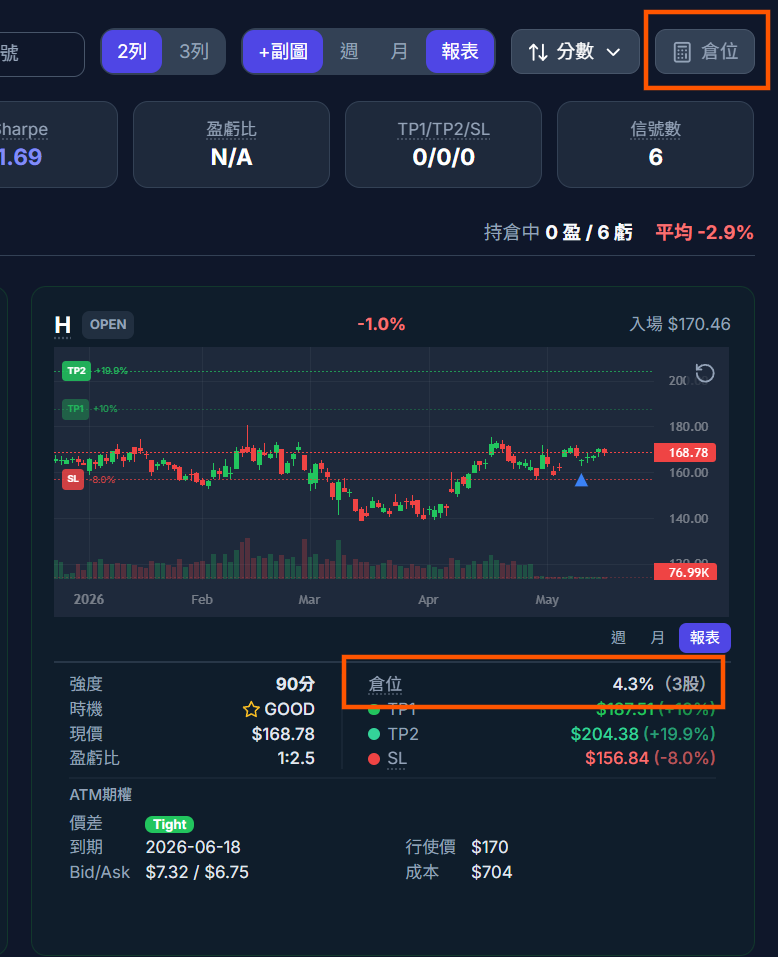
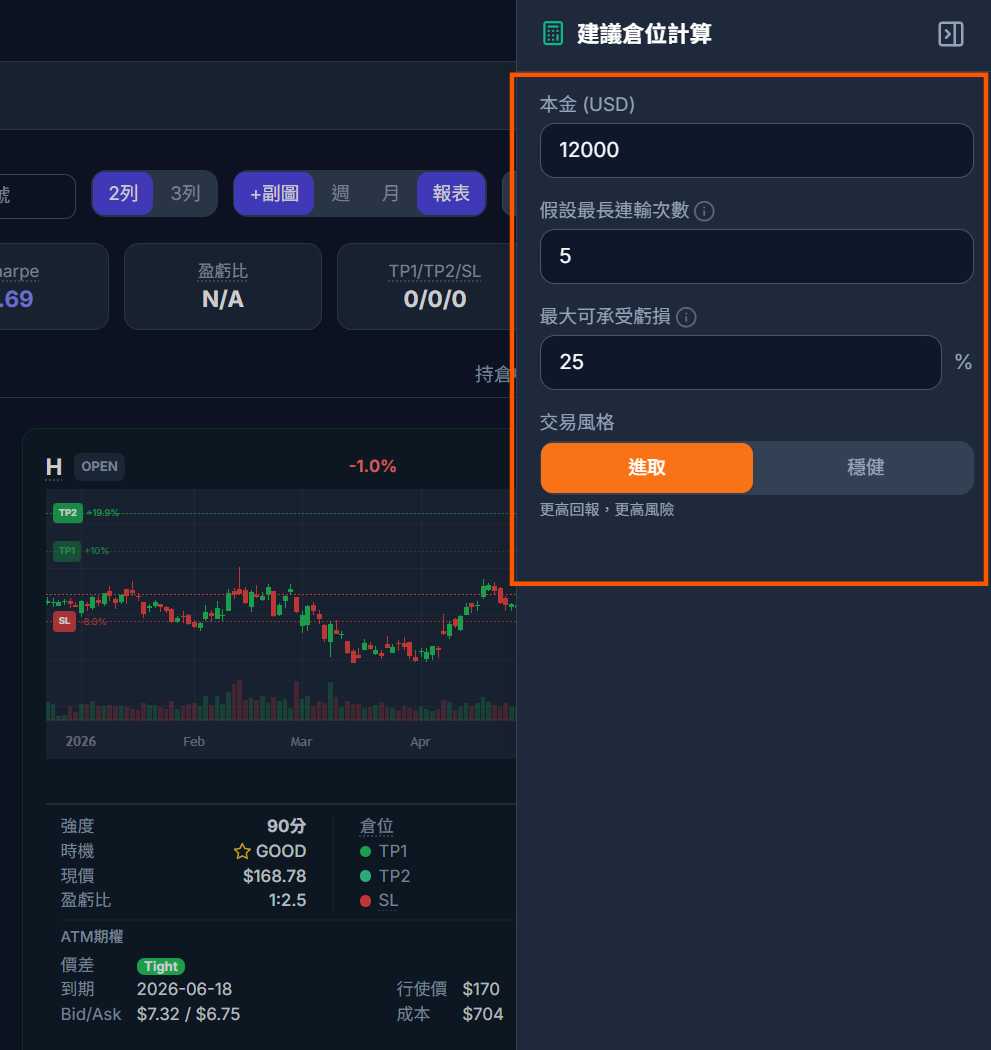
Now that you understand the theory, you may still wonder in practice: how much capital should I allocate to each stock? Is the calculation complicated?
This is where Algo Lab''s "Recommended Position" feature comes in.
You only need to enter four simple pieces of information:
- Your Capital — The total funds you plan to commit to trading
- Maximum Acceptable Loss — The maximum loss range you can psychologically accept
- Consecutive Loss Count — In the worst case, how many consecutive losses do you expect?
- Trading Style — Are you aggressive or moderate?
The system will automatically calculate the recommended position amount and percentage for each signal stock based on your inputs. You don''t need to calculate yourself or rely on gut feelings — everything is based on scientific risk management principles, clear and precise.
🚀 Ready to Get Started?
Go to the Strategy 1: Cup and Handle Breakout page now to view the latest trading signals and use the "Recommended Position" feature to create a scientific risk plan for every trade.